

Monday, May 4, 2026
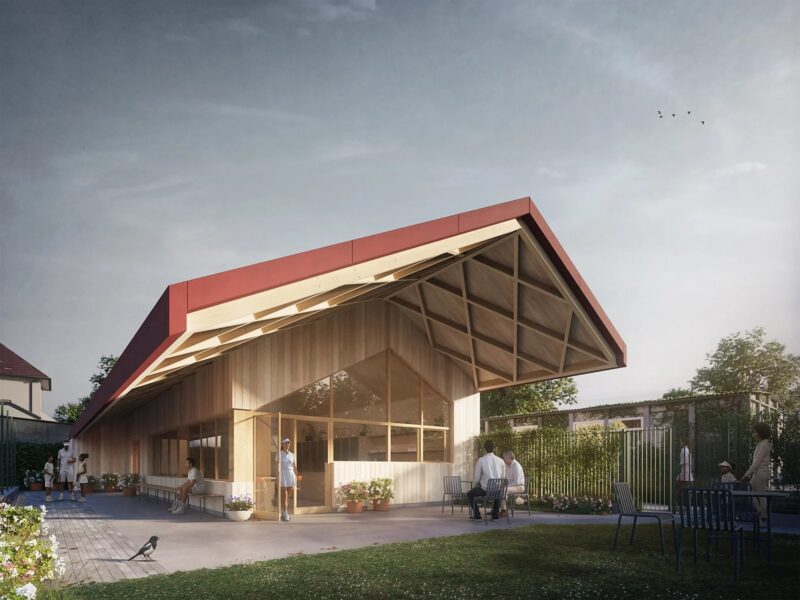
A new chapter in UK community sports architecture has been approved in Sutton, London, where RISE Design Studio has secured planning permission to redevelop Sutton Churches Tennis Club using a hybrid mass timber approach. The project is positioned as one of the first of its kind in the country, combining cross-laminated timber (CLT) and glulam construction while targeting AECB CarbonLite New Build certification.
The redevelopment replaces an ageing and dilapidated clubhouse that has been deemed no longer fit for purpose. It will be delivered as a single-storey pavilion designed to serve both current members and future generations of players. The design includes an enlarged clubroom, upgraded changing facilities, accessible toilets, and integrated storage spaces. The building has been planned to evolve with the needs of the club over time.
Planning consent has been granted by the London Borough of Sutton with full council backing. Construction is expected to begin in early 2027. The approval reflects growing support for low-carbon community infrastructure across the UK.
The pavilion adopts a hybrid structural system using CLT wall panels and glulam roof beams. The structure is designed for off-site fabrication, allowing components to be manufactured in controlled factory conditions before being transported to site. This approach significantly reduces on-site construction time. It also reduces embodied carbon compared to traditional construction methods.
Assembly on site is expected to be rapid. Modules will be lifted into position within a tightly managed programme. Costs associated with extended on-site labour are expected to be reduced. The design has been shaped by budget constraints typical of community sports facilities.
RISE Design Studio has emphasised that the project aims to restore architectural quality to grassroots sports infrastructure. According to Design Director Imran Jahn, high-quality architecture should not be limited to premium developments. It should also be accessible to community organisations operating on restricted budgets. His statement underlines the design philosophy behind the project.
The pavilion has been designed with strong sustainability principles. It will operate using mechanical ventilation with heat recovery systems and air-source heat pumps. Rooftop photovoltaic panels will contribute to on-site energy generation. Airtight construction standards have been prioritised to reduce energy demand.
AECB CarbonLite New Build certification is being targeted for both operational and embodied carbon performance. This standard is increasingly adopted in low-energy building projects across the UK. It is considered particularly relevant for community-led developments where long-term running costs are a major concern.
Accessibility has been embedded into the core design strategy. The ground floor has been lowered to align with surrounding landscape levels. This allows step-free access throughout the pavilion. The design removes the need for retrofitted accessibility solutions. Inclusion has been treated as a primary design requirement rather than an afterthought.
The spatial layout follows a clear linear zoning strategy. The western side of the site is dedicated to recreational landscape areas. The central zone contains the main social hub and clubroom. The eastern boundary accommodates service functions and operational support spaces. This arrangement ensures functional clarity and efficient circulation.
The clubroom has been positioned to overlook the tennis courts. It is oriented northwards to maintain visual connection with sporting activity. Large openings frame views across the courts, reinforcing community engagement with the game.
Material selection has been deliberately restrained. Timber, metal, and glass form the primary palette. Vertical timber cladding softens the building’s visual impact. A standing seam metal roof provides durability and weather protection. A generous roof overhang offers shading and shelter.
A red-toned roof finish has been introduced as a visual reference to surrounding residential architecture. A central rooflight runs through the building to maximise daylight penetration. Artificial lighting demand is expected to be reduced as a result.
To the eastern edge, an ancillary block has been designed as a buffer zone. It provides acoustic protection for neighbouring properties. High-level windows allow daylight entry while maintaining privacy. This element of the design has been carefully integrated.
The scheme reflects a wider shift in UK construction towards mass timber solutions. Across Europe and the UK, CLT and glulam buildings are increasingly used in public, commercial, and community projects. The approach is seen as a response to ageing building stock and rising carbon reduction targets.
RISE Design Studio stated that early coordination was critical to achieving AECB standards. The design process required careful integration of environmental performance and spatial planning. The building has been shaped through iterative technical development.
According to Senior Architect Jose Dengra, the scheme responds directly to its context while meeting high environmental and accessibility expectations. Careful design coordination has been essential to ensuring deliverability within budget constraints.
Community feedback has also influenced the project. Representatives from Sutton Churches Tennis Club noted that the existing facility had become a barrier to participation. It was described as limiting growth and inclusion within the club.
The approved pavilion is expected to address these issues by providing improved facilities and a more welcoming environment. It is designed to support increased participation and long-term community use.
Works are scheduled to begin in early 2027. Once completed, the pavilion will stand as RISE Design Studio’s first dedicated community sports building. It is also positioned as a model for future low-carbon, timber-based community infrastructure across the UK.
Read more news on Timber construction
Get more updates on American woodworking industry through: www.woodandpanel.us
Tags: CLT glulam construction UK, mass timber pavilion, prefabricated timber architecture, Sutton tennis club redevelopment, woodworking and processing, woodworking UK






Comments: