

Tuesday, November 11, 2025
The construction industry is traversing a rapid evolution, driven by the dual pressures of a persistent skills shortage and an urgent mandate for sustainable building practices. Addressing these challenges requires a fundamental shift in vocational education, a shift currently being spearheaded by the new T Level qualifications in England.
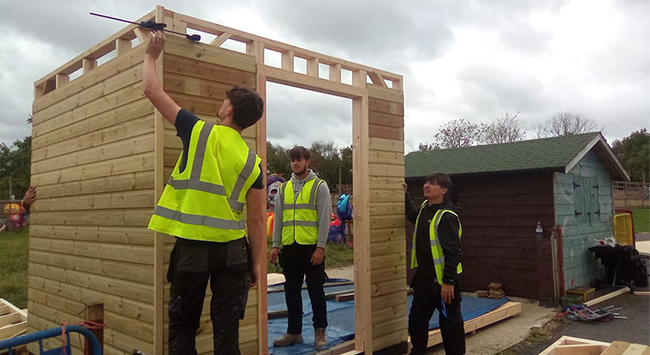
A prime example of this innovative, industry-led approach is the ongoing project at Valley Wildlife, where a cohort of T Level Joinery students is moving beyond traditional classroom theory to gain invaluable, real-world experience. These learners are not just practising bench skills; they are applying their technical knowledge to live construction tasks that are directly supporting local UK wildlife conservation efforts. This collaboration effectively links the technical demands of the construction industry with the critical needs of the environmental sector.
The core of the students’ placement involves hands-on work with wood structures critical to the wildlife centre’s operations. The projects include the construction and repair of a diverse range of wooden installations, such as:
This is far removed from simulated workshop exercises. The students are exposed to the full lifecycle of a construction project, from interpreting client briefs (the conservation team’s needs) and material sourcing to execution on a working, unpredictable site environment. They must factor in variable conditions, liaise with non-construction professionals, and solve real-time problems, all of which are essential attributes for any skilled tradesperson entering the industry.
Learning sustainable construction in a live environment
One of the most significant takeaways from this placement is the direct exposure to sustainable building practices. Working on a wildlife site fundamentally shifts the focus from purely economic efficiency to environmental responsibility.
The joinery students are gaining first-hand insight into:
Working alongside industry professionals—whether they be experienced carpenters, site managers, or the conservation experts themselves—provides mentorship that transcends purely technical skills. Students gain a holistic understanding of how their craft plays a direct role in the broader social and environmental goals of a community-based project, reinforcing the industry’s shift toward a more responsible, conscious approach.
The T Level advantage
The T Level qualification is explicitly designed to address the construction industry’s demand for job-ready entrants. Equivalent to three A-Levels, the two-year course integrates rigorous classroom study (80% of the course) with a mandatory, substantial industry placement (a minimum of 315 hours, or approximately 45 days).
For these joinery students, the Valley Wildlife placement is the linchpin that turns theoretical knowledge into practical competence. The experience ensures they are not just knowledgeable about health and safety regulations or structural principles, but are proficient in executing them in a live, unpredictable work setting.
The skills gained in this environment are highly transferable:Technical Skill Acquired Industry Application Complex Joinery & Framing First-fix carpentry on residential and commercial sites (roofing, partitions). Site Logistics & Planning Coordinating work schedules and materials on-site, a step toward site management roles. Sustainable Timber Use Working on Net-Zero construction projects and retrofitting for energy efficiency. Problem-Solving & Adaptability Essential for custom work, bespoke architectural joinery, and dealing with unforeseen site challenges.
By completing projects like the ones at Valley Wildlife, the students are building a comprehensive portfolio and developing the confidence necessary to transition immediately into skilled employment, a higher-level apprenticeship, or further education.
This collaboration is a powerful testament to the effectiveness of the T Level model, demonstrating how vocational education can concurrently enhance a student’s career prospects and deliver tangible benefits to the local community and environment. The integration of high-level technical skills with an understanding of conservation needs is not just an educational success; it is a blueprint for the future of a more responsible, highly skilled construction workforce in the UK.
Read more news on: carpentry
Get such updates through woodandpanel.us
Tags: construction career pathway, Joinery industry placement, on-site carpentry, skilled trades development, sustainable building practices, T Level Construction








Comments: