

Tuesday, October 28, 2025
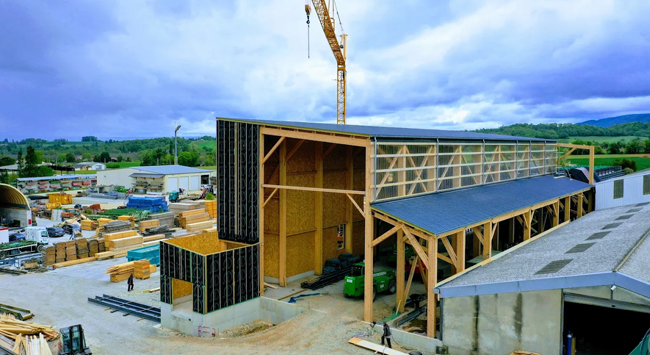
In the heart of France’s timber-rich Rhône-Alpes region, the fourth generation of the family-run sawmill Scierie Blanc is embarking on a pivotal production expansion aimed at nearly tripling output by next year. The move positions them to capitalise on growth in the woodworking and structural timber sectors and respond to rising demand across the country’s wood–based construction industry.
As of 2023, Scierie Blanc was producing around 45,000 m³ of sawn timber per annum from softwood species such as spruce, fir, and Douglas fir. To capitalise on increasing market demand, the company has set its sights on surpassing the 100,000 m³ output mark by early next year—more than doubling production and approaching a tripling scale.
Central to this growth strategy is a sweeping investment in automation and sorting technology. The organisation collaborated with German engineering firm Kallfass to install a 130-metre two-level sorting system with 79 vertical boxes—the largest of its kind in France. This system upgrades the sawmill’s capacity to process a wide range of board widths (75–250 mm) and thicknesses (18–100 mm), thereby offering more versatility to timber-construction customers.
Strategic drivers
Scierie Blanc’s expansion reflects broader trends in the French woodworking and timber construction sectors. As the demand for wood-based building materials grows—driven by sustainability targets and increased adoption of timber structures—sawmillers with capacity, agility, and added-value capabilities are gaining a competitive advantage. As Blanc explains: “The demand is there and will continue to increase in the future.”
By increasing throughput and range, Blanc aims to win customers previously sourcing from Scandinavian producers, offering equal product quality combined with shorter delivery times and local value-added services. This strategy is directly aligned with industry commentary suggesting that French sawmills must raise production and diversify output to meet both domestic and export-market wood-construction needs.
Operational implications
The ramp-up at Blanc will have some implications for the woodworking supply chain:
Challenges, yet optimism
While Blanc’s ambitions are ambitious, the expansion comes with operational and market challenges: sourcing sufficient logs of the required species and dimensions, ensuring consistent supply amid forest-resource pressures, and maintaining yield and quality in a high-volume environment. The initial investment in infrastructure, building modifications, and technology adds upfront cost, but management sees this as key to long-term competitiveness.
Nevertheless, Blanc remains confident. Their view is that by investing now, they can better serve the timber-construction wave, improve delivery flexibility, and capture a stronger market share regionally.
For the woodworking and sawmilling industry in France and across Europe, Scierie Blanc’s case signals a few broader takeaways:
The expansion of the family-run Scierie Blanc in the Rhône-Alpes region is a clear signal of how sawmills are adapting to shifting market dynamics. By targeting more than doubling output to over 100,000 m³, installing cutting-edge sorting and automation systems, and aligning product range with timber-construction demands, Blanc is positioning itself for the next phase of wood-products growth in France. For woodworking industry players—from sawmills to structural timber manufacturers—the message is clear: scale, flexibility, and value-added capability matter more than ever in a market where wood construction is gaining ground and lead time, quality, and service are critical.
Read more news on: engineered wood, automation, glulam
Get such updates through woodandpanel.us
Tags: automation in sawmills, Blanc sawmill France, French sawmill expansion, Scierie Blanc, timber supply chain France, wood industry modernization







Comments: