

Tuesday, November 4, 2025
The digital age, powered by the continuous flow of information, rests on an unseen foundation: data centres. These industrial-scale facilities house the servers that run everything from global finance and healthcare to social media and the burgeoning field of Artificial Intelligence. As global internet traffic has surged—expanding over 25-fold since 2010—the demand for data centre infrastructure has skyrocketed, a trajectory only accelerating with the rise of AI. However, this engine of the modern world comes with a significant environmental cost.
Traditionally, data centres are built using carbon-intensive materials like steel and concrete. While these materials offer perceived strength and security for critical infrastructure, their production is responsible for a massive share of global industrial emissions: cement production accounts for approximately 8% of global CO₂ emissions, and steel production around 7%.
A sustainable approach to digital infrastructure must look beyond just operational energy consumption and address the total lifecycle impact, including the embodied carbon associated with materials and construction. The urgent need for both sustainable and climate-resilient infrastructure has driven a profound search for alternatives—and the answer is being found in a time-tested material: wood.
EcoDataCenter and mass timber
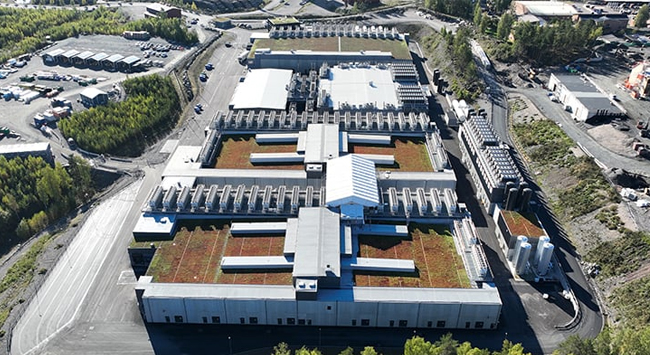
In the historical Swedish city of Falun, a pioneering collaboration has delivered a scalable blueprint for the next generation of digital infrastructure. Established in 2014, EcoDataCenter set out with an ambitious vision: to construct one of the world’s most sustainable data centres. In 2019, this vision was realised with the opening of EcoDataCenter 1, the world’s first large-scale data centre built using Cross-Laminated Timber (CLT), a key form of mass timber, and entirely powered by renewable energy.
This groundbreaking project was a joint effort with the main contractor and timber specialist ByggPartner, utilising engineered wood supplied by the renewable materials company, Stora Enso. The choice of material was deliberate and rooted in local expertise. “There’s a long tradition of building with CLT in Sweden,” explains John Wernvik, Chief External Relations & Sustainability Officer at EcoDataCenter. “We knew we could draw on that heritage and a strong network of local suppliers. By building in wood instead of steel, we also cut embodied carbon significantly.”
The facility’s structure, which is now nearly 95% CLT, offers a direct, powerful antidote to the carbon footprint of conventional construction, redefining what is possible for critical technological buildings.
A carbon sink for critical infrastructure
Mass timber, which includes products like CLT, Glulam, and LVL, is rapidly gaining credibility as a high-performance alternative to concrete and steel. Its advantages are numerous, but the climate benefits are the most compelling:
For data centers specifically, mass timber delivers unique functional benefits. The prefabrication of CLT panels in factory-controlled environments—a service offered by companies like Stora Enso—ensures high precision and enables a just-in-time delivery model, leading to faster, quieter, and more efficient on-site assembly. This speed is a crucial advantage in the fast-paced data centre sector.
Furthermore, the structure provides essential flexibility for adapting to ever-changing technological needs. As Wernvik notes, the ability to modify the structure for new pipes, cables, and cooling systems by simply cutting through the timber is a major operational benefit, simplifying maintenance and future upgrades.

Overcoming hurdles: Fire safety, security, and acceptance
As a pioneer, EcoDataCenter faced the inevitable challenges of introducing a non-traditional material into a conservative and high-security industry. Convincing global clients and adhering to stringent international standards—especially concerning fire safety and security—took significant effort.
However, the team, in close collaboration with partners like ByggPartner, Limträteknik, and Stora Enso, drove innovation to address these concerns. Modern mass timber design incorporates principles of fire safety through charring, where the outer layer of wood burns predictably and slowly, forming an insulating char layer that protects the inner structural core. Continuous refinement and engineering breakthroughs, such as Stora Enso’s CLT being approved for the stringent SK3 burglary resistance demanded by the industry, have demonstrably proven the material’s viability for mission-critical infrastructure.
The success of the Falun project has catalyzed a profound shift in the industry’s mindset. “Acceptance has shifted dramatically,” says Wernvik, citing recent announcements from tech giants like Microsoft and Meta to pilot hybrid mass timber structures for their own data center campuses. This global trend confirms that the question is no longer if engineered wood can be used, but how quickly it will become the industry standard.
Beyond materials: Circularity and community integration
The innovations in Falun extend beyond the building’s material composition. EcoDataCenter’s model is built on principles of circularity and community integration, ensuring the facilities are part of a sustainable local ecosystem.
Excess heat generated by the servers is captured and fed into the local energy system, a crucial feature in the cold Nordic climate. By working closely with the local energy company, they turn “waste” into a valuable resource, strengthening the municipal grid and supporting the city’s continued growth. This model embodies the future vision of data centers—not as isolated, energy-hungry monoliths, but as fully integrated assets within the local society and energy system.
The continuous, iterative process of development, from EcoDataCenter 1 to new expansion modules in Falun and the in-progress EcoDataCenter 2 in nearby Borlänge, demonstrates that this sustainable blueprint is highly scalable. Each project is an opportunity for refinement, leveraging lessons learned to continuously raise the bar for low-carbon, resilient construction.
The path forward
The global tech industry is at a pivotal moment. As the demand for computing power surges, data center owners and developers are recognising that achieving meaningful climate targets requires tackling both operational and embodied carbon.
The EcoDataCenter project in Sweden, spearheaded by the commitment of companies like ByggPartner and Stora Enso, provides the definitive proof-of-concept. Mass timber construction works at scale, offering high performance, rapid assembly, and unparalleled climate benefits. As climate pressures increase, the flexible, adaptable, and carbon-storing characteristics of engineered wood are making it an essential material for building a truly resilient and sustainable digital future.
Explore WOODWORD for more articles
Also, follow Woodworking News for daily updates
Tags: CLT, construction innovation, EcoDataCenter, Embodied Carbon, green building, mass timber, renewable energy, Stora Enso











Comments: