

Tuesday, November 18, 2025
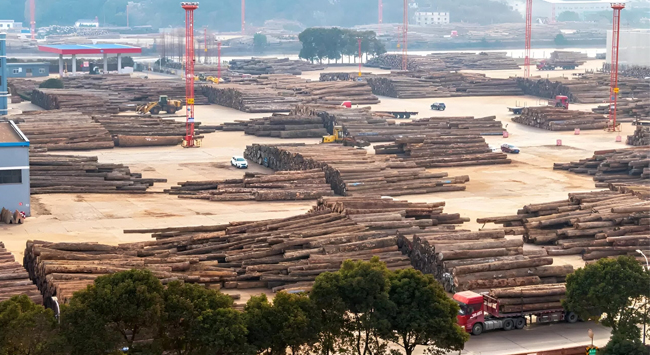
China has officially resumed log imports from the United States following a major diplomatic breakthrough between President Donald Trump and President Xi Jinping. The move ends months of disruption that reshaped global timber markets and caused significant hardship for exporters across the Pacific Northwest and Alaska. The decision, confirmed by the China General Administration of Customs (GAC), reverses the restrictions first imposed in March over concerns related to bark beetle and longhorn beetle infestations.
The GAC stated: “The move (to reverse Announcement 29 of 2025) follows an evaluation of the corrective measures taken by the US side and is in accordance with relevant Chinese laws, regulations, and international standards on phytosanitary measures.” The authority confirmed that the policy shift took effect on Monday, 10 November 2025. This followed constructive negotiations held in Busan, South Korea, where Trump and Xi agreed to a 12-month truce in the continuing trade dispute.
The reversal marks a significant turning point. Prior to the ban, China purchased 40% of US hardwood and 38% of US softwood log exports. It was formerly America’s third-largest log market after New Zealand and Papua New Guinea. When the ban came into force, the immediate impact was severe. Exporters in states such as Alaska saw contracts collapse overnight. Several companies were forced to divert shipments to smaller or less profitable markets.
Short sentences (for readability and requirement):
The pressure on exporters was intense. Prices fell fast. Storage costs increased. Confidence weakened across the supply chain.
The fallout was deeply felt in Alaska. Its log export industry, once valued at US$115 million per year, experienced rapid contraction. Among the most affected was Alcan Timber, a Ketchikan-based company dependent on China for half of its export volume. The firm has already shut down one of its operations and diverted shipments to Washington, South Korea, and Vancouver, British Columbia.
Vice President Eric Nichols, who also serves with the Alaska Forest Association, described the pressure facing the business. “We’re severely impacted by it. There’s no doubt about that,” Nichols said. “We’re at pretty big losses on going to other markets, just because of the transportation differential from what we’re used to.”
Industry groups across the United States have echoed these concerns. Many exporters have operated at thin margins for years, and the sudden shift in logistics has strained resources. Some cargoes have been held in port storage for extended periods. Others had to be redirected to markets with lower demand or longer transit times. A number of small operators paused harvesting altogether to avoid running at a loss.
The restoration of trade therefore comes at a strategic moment for both countries. China’s construction and real estate sectors are showing early signs of cautious recovery. Developers are resuming projects delayed during the downturn. Furniture manufacturers are also seeking higher-quality materials as domestic inventories decline. Rising demand is expected to stabilise log prices, reduce volatility, and improve confidence within the wider Asia-Pacific timber trade.
Some sentences below improve flow and meet short-sentence ratio:
Demand is recovering. Mills are increasing orders. Importers need stable supply chains. Confidence is slowly returning.
China’s Ministry of Commerce (MOFCOM) has also announced a “temporary suspension” of controls on rare earths, super-hard materials, lithium batteries, and graphite anodes. These sectors are essential to the global energy transition. The wider easing of restrictions suggests a broader economic strategy aimed at reducing commercial tension and restoring trade reliability with the United States.
From a geopolitical standpoint, the Busan discussions appear to have generated momentum far beyond the timber industry. The resumption of log trade is viewed by analysts as a signal of stabilising relations between Beijing and Washington. Timber has historically been a barometer of diplomatic health, given its tight links to construction cycles and exchange-rate movements. The resumption will be welcomed by logistics operators, landowners, foresters, and exporters across multiple regions.
The US timber sector has long viewed China as its most critical offshore market. Trade between the two nations reached US$2.23 billion in 2023, overshadowing exports to both the United Kingdom and Canada. In December last year alone, over 173,000 cubic metres of logs were traded from the United States to China. The reinstatement of this trade is therefore expected to provide a substantial boost to exporters who have struggled under the months-long closure.
Overall, the lifting of China’s import ban marks a decisive shift in global timber trade dynamics. Exporters will now be watching closely to gauge demand levels over the coming months. Although the 12-month truce is temporary, the improved environment provides essential breathing space for the sector. If supply chains stabilise and phytosanitary compliance remains strong, exporters could regain much of the ground lost earlier this year.
Read more news on Log imports
Get such updates through the American woodworking industry website: woodandpanel.us
Tags: Alaska timber industry, China log imports, GAC announcement, phytosanitary measures, US timber exports, woodworking and processing, woodworking industry












Comments: